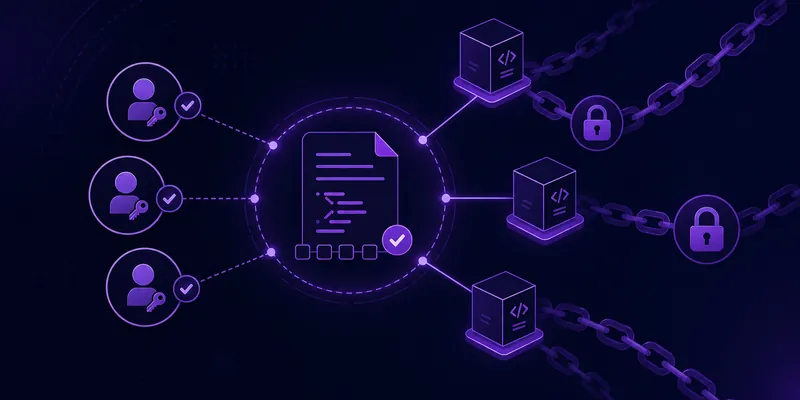
Escrow is the mechanism that makes darknet market transactions possible in the absence of legal enforcement. Without it, every transaction would require either the buyer or the vendor to trust the other party completely — an untenable proposition given the anonymous nature of these markets. Multi-signature escrow, often called multi-sig, goes further than traditional centralised escrow by ensuring that even the platform itself cannot unilaterally move funds. An August 2025 update to the platform's multi-sig implementation brings several important improvements to this critical financial infrastructure.
The multi-sig escrow model used on the platform follows the standard 2-of-3 key arrangement. In this model, three parties each hold one cryptographic key: the buyer, the vendor, and the platform acting as arbitrator. To release funds from escrow, two of the three parties must sign the release transaction. Under normal circumstances — a completed order where both parties are satisfied — the buyer and vendor co-sign the release and funds move to the vendor without the platform ever needing to act. The platform's key exists only as a tiebreaker in the event of a dispute.
Why 2-of-3 Multi-Sig Matters
The key security property of this arrangement is that neither the platform nor any single party can steal the escrowed funds alone. Even if the platform's server infrastructure were compromised, an attacker would only obtain one of the three keys — insufficient to construct a valid release transaction. This is a substantial improvement over traditional escrow, where the marketplace controls all funds and could theoretically disappear with them at any time.
For buyers, this translates to a meaningful reduction in exit-scam risk. The platform cannot access buyer funds without either the buyer's or vendor's co-signature. For vendors, it provides assurance that their earnings will be released promptly once an order is finalised, without depending on a centralised operator's solvency or honesty. This architecture has become an industry standard that users of Nexus Access can rely on as a baseline protection mechanism.
What Changed in the August Update
The most user-facing change in this update is the extension of dispute windows. Previously, buyers had a fixed period after an order's estimated delivery date to raise a dispute. The updated system introduces variable dispute windows based on the nature of the order and the vendor's tier status. International orders, which are inherently subject to greater delivery variability, now receive extended windows of up to 21 days past the estimated delivery date. High-value orders above a certain threshold automatically receive additional dispute time regardless of delivery method.
The key management improvements are more technical but equally significant. The previous implementation generated the platform's arbitration key in a manner that stored certain key material in memory in ways that could theoretically be exploited. The updated system uses a hardware security module approach for the platform's portion of the key, meaning the arbitration key is never directly exposed to the platform's main application server. This reduces the attack surface for any adversary attempting to compromise the platform's arbitration capability.
Additionally, the update introduces improved key backup and recovery procedures for buyers who lose access to their private key before finalising an order. Previously, a lost buyer key could result in funds being permanently locked in escrow. The new system provides a cryptographically secure key recovery path using the buyer's account credentials and a secondary recovery code generated at wallet setup. Users are strongly advised to store this recovery code securely and separately from their account password.
How to Protect Yourself as a Buyer
Understanding how to use the escrow system effectively is as important as the technical improvements behind it. Always use multi-sig escrow rather than finalising early — vendors may sometimes request early finalisation, but this waives your dispute rights. Keep records of all order communications using the encrypted messaging system, as these will be essential evidence if a dispute arises.
If an order does not arrive, raise a dispute within the window rather than waiting. Dispute evidence should include message logs, the order details, and any tracking information provided by the vendor. The platform overview explains the dispute process in detail, and the FAQ section covers common scenarios such as partial deliveries and incorrect items. Being informed about your rights and the dispute timeline before you need to use them makes the process considerably smoother.
← Back to News