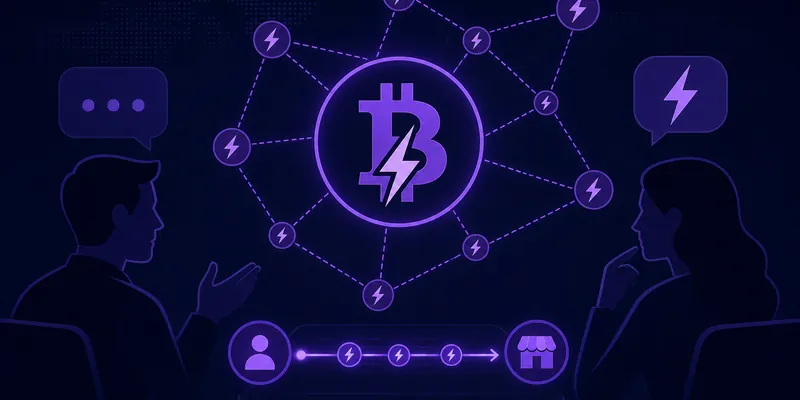
The Lightning Network has become one of the more actively debated topics in the platform community forum over the past month, following renewed discussion about the trade-offs of integrating off-chain Bitcoin payment channels alongside the existing cryptocurrency options. Understanding what Lightning Network is, how it works technically, and what its privacy implications are for darknet market use requires engaging with a set of concepts that differ substantially from on-chain Bitcoin transaction handling.
How Lightning Network Works
Lightning Network is a layer-two payment system built on top of the Bitcoin blockchain. Its core concept is the payment channel: two parties lock a certain amount of Bitcoin into an on-chain multi-signature transaction, and can then transact between themselves an unlimited number of times without publishing each transaction to the blockchain. Only the channel opening and closing transactions appear on-chain; all intermediate transactions are handled off-chain through cryptographically signed balance updates. This dramatically reduces per-transaction fees and increases throughput compared to on-chain Bitcoin, which is constrained to approximately seven transactions per second network-wide.
The Lightning Network extends this channel concept across multiple hops through routing. If Party A has a channel with Party B, and Party B has a channel with Party C, Party A can send a payment to Party C routed through Party B—without A and C having a direct channel. Routing is enabled by Hash Time-Locked Contracts (HTLCs), a cryptographic construction that ensures the routing payment is atomic: it either completes fully or fails without funds leaving the sender.
Routing nodes—participants who maintain channels with multiple counterparties and forward payments—earn small fees for this service. The Lightning Network has evolved into a network of thousands of routing nodes, with the largest nodes handling the majority of forwarded volume due to network effects that favor well-connected, high-liquidity nodes.
Privacy Trade-offs vs On-Chain Bitcoin and Monero
Lightning Network's privacy model differs fundamentally from both on-chain Bitcoin and Monero. The channel graph—the network of open payment channels—is largely public. When you open a channel with a counterparty, that on-chain transaction reveals the participants' Bitcoin addresses and the channel capacity. Channel graph analysis tools allow researchers and blockchain analytics companies to map Lightning Network topology in detail, identifying which nodes are highly connected, what their liquidity profiles are, and in some cases correlating node identities with IP addresses (particularly for nodes that do not use Tor).
Payment routing through Lightning is not fully private. While the source and destination of a payment are not revealed to every routing node in the path—Lightning uses an onion routing scheme similar in concept to Tor—intermediate routing nodes learn the previous and next hop in a payment chain, which allows a sophisticated adversary controlling multiple routing nodes to potentially perform path correlation attacks. The sender and receiver's channel counterparties also learn transaction amounts and timing.
For custodial Lightning wallets—where a third party controls the Lightning node on the user's behalf—the custodian has complete visibility into the user's payment activity. This is a critical distinction: custodial Lightning offers the speed and low-fee benefits of off-chain payments but eliminates the self-sovereign privacy model that makes cryptocurrency relevant in sensitive contexts.
Monero's privacy model addresses these concerns at the protocol level through ring signatures (which obscure the true sender among a set of decoys), stealth addresses (which prevent linking the recipient's public address to the on-chain transaction), and RingCT (which hides transaction amounts). On-chain Monero transactions are private by default for all participants without requiring careful wallet selection or channel management. The cryptocurrency guide covers the technical implementation of Monero's privacy features in detail, as well as the comparative privacy analysis of Bitcoin vs Monero for sensitive use cases.
Community Response
Forum discussion of potential Lightning integration has been divided along predictable lines. Users prioritizing transaction speed and lower Bitcoin fees have expressed interest in Lightning as a supplement to existing options, particularly for smaller transactions where on-chain fee uncertainty is frustrating. The technical convenience argument is genuine—Lightning payments confirm in seconds rather than waiting for block confirmations.
The majority of community security-focused discussion has landed on skepticism, citing the channel graph visibility, the routing node exposure, and the complexity of achieving meaningful privacy with Lightning compared to simply using Monero. The consensus that has emerged from extended forum threads is that Lightning BTC is more private than raw on-chain Bitcoin for small-value frequent transactions, but less private than well-practiced on-chain Bitcoin with proper coin control, and substantially less private than Monero for any use case where financial privacy is important. No integration announcement has been made.